
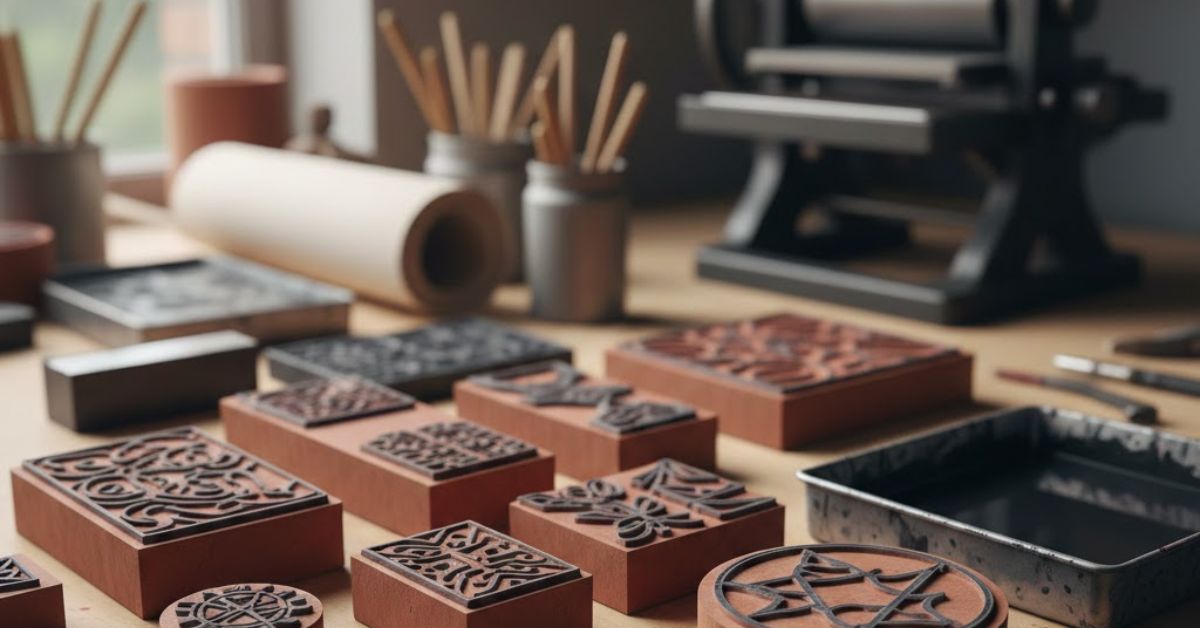
Rubber dies do not get much attention. They are rarely talked about in detail. But when a job depends on clean impressions, consistent pressure, and repeatable results, rubber printing dies quietly carry a lot of responsibility.
At PlateCrafters, we spend a good amount of time thinking about that responsibility. We design and produce rubber printing dies that are meant to work. Not just once. Not just under perfect conditions. But day after day, in real production environments where presses run long hours and expectations are high.
This is how we approach rubber dies, and why our role as rubber platemaking manufacturers goes far beyond simply supplying a product.
What Are Rubber Printing Dies Really Used For?
Rubber printing dies are chosen for a reason. They offer flexibility where rigid materials cannot. They adapt to uneven surfaces. They absorb pressure. They create impressions that feel controlled rather than harsh.
Because of that, rubber dies are often used in applications where consistency matters more than sharp metallic edges. They are expected to perform without damaging substrates or creating excessive wear on equipment.
That expectation puts pressure on the die itself. If the rubber formulation is wrong, impressions suffer. If the die is poorly made, problems show up fast.
We take that seriously.
Why Material Choice Is Not a Small Detail
Not all rubber behaves the same. That is something people learn quickly once they start running jobs at scale.
Some rubber compounds wear down too fast. Others lose shape under pressure. Some fail to recover properly after repeated use. These issues are rarely obvious at the start, but they become impossible to ignore over time.
At PlateCrafters, we choose materials based on how the die will actually be used. We consider pressure levels, run length, and the type of surface being printed. That helps us create rubber printing dies that hold their form and deliver consistent impressions instead of drifting over time.
Good rubber dies should feel predictable. That predictability starts with material selection.
The Manufacturing Process Matters More Than People Think
Being rubber platemaking manufacturers means more than shaping rubber into a usable form. The process behind it matters just as much as the material itself.
Depth control. Surface consistency. Clean edges. These factors affect how evenly pressure is distributed and how stable the die remains during production.
We focus on precision without turning the process into something overly complicated. Rubber dies do not need excess refinement. They need thoughtful construction.
At PlateCrafters, our approach is built around practical outcomes. Does the die mount easily? Does it stay stable? Does it perform the same way across repeated runs? Those questions guide every decision we make.
Rubber Dies and Real Press Conditions
Press conditions are rarely ideal. Pressure shifts slightly. Materials vary. Operators make adjustments to keep things moving. Rubber printing dies need to handle those realities without falling apart or losing definition.
This is where experience as rubber platemaking manufacturers shows up.
We design dies that work within those variables. A well-made rubber die absorbs pressure changes instead of amplifying them. It changes instead of fighting back. That flexibility makes things easier on both the press and the final product.
When a die works the same way every time, it’s easier to keep track of the whole process.
File Preparation Still Plays a Role
Even though rubber dies are more forgiving than rigid alternatives, preparation still matters.
Artwork that is too dense, transitions that are too tight, or designs that ignore how rubber behaves under pressure can lead to disappointing results. We review files with those realities in mind.
Our goal is not to overcorrect or redesign. It is to make sure the die has what it needs to perform well once it reaches the press.
This early attention often prevents issues that would otherwise appear mid-run, when changes are harder and more expensive.
Why Customization Matters in Rubber Die Work
One of the biggest mistakes people make with rubber printing dies is assuming they are interchangeable. They are not.
Different jobs call for different approaches. The same die design will not perform the same way across every application. Thickness, relief depth, and rubber hardness all influence the outcome.
At PlateCrafters, we tailor our rubber dies to the job instead of forcing the job to fit the die. That flexibility is part of what defines us as rubber platemaking manufacturers.
It also helps ensure that the die supports the work rather than complicating it.
What Working with PlateCrafters Feels Like
We keep things straightforward. Clear communication. Thoughtful questions. No unnecessary complexity.
When customers work with PlateCrafters, they are not handed a generic solution. They are working with a team that understands how rubber printing dies behave under real conditions and builds accordingly.
Our role does not end when the die leaves our facility. Everything we do leading up to that point is meant to make the pressroom experience smoother.
That mindset shapes how we operate.
Consistency Is the Real Measure of Quality
Anyone can make a die that works once. Quality shows up when it works again. And again. And again.
As rubber platemaking manufacturers, we judge our work by how it holds up over time. Does the impression stay clean? Does the die maintain its shape? Does it continue to perform without constant adjustment?
Those are the standards we measure ourselves against.
Closing Thoughts
Rubber printing dies may not get the spotlight, but they play a critical role in many printing applications. When they are made with care, they quietly support consistent, reliable production.
At PlateCrafters, we build rubber printing dies with real-world use in mind. Our experience as rubber platemaking manufacturers guides every choice we make, from material selection to final production.
When the die is right, the process feels controlled. The results feel dependable. And the work moves forward without unnecessary friction. That is the outcome we aim for every time.
FAQ’s
Rubber printing dies are essential tools in stamping, embossing, and printing industries. Here are some frequently asked questions about rubber printing dies:
Rubber printing dies are engraved or molded rubber tools used to transfer ink, impressions, or designs onto various surfaces. They are widely used in packaging, stationery, and promotional materials for high-quality, repeatable prints.
Rubber printing dies can be used on paper, cardboard, fabric, leather, plastic, and foil. They are versatile and can create precise imprints on both flat and slightly textured surfaces.
Rubber printing dies are typically produced by engraving or molding rubber sheets to match a design. The rubber is then mounted onto a base or cylinder for stamping, embossing, or hot/cold foil printing applications.
Rubber printing dies offer durability, flexibility, and precise design replication. They are ideal for repetitive printing tasks, maintaining consistent quality, and allowing customization for logos, text, or decorative patterns.
Rubber printing dies are used in packaging, labeling, greeting cards, promotional products, leather goods, and textile printing. They are especially popular for applications requiring detailed impressions and professional finishes.